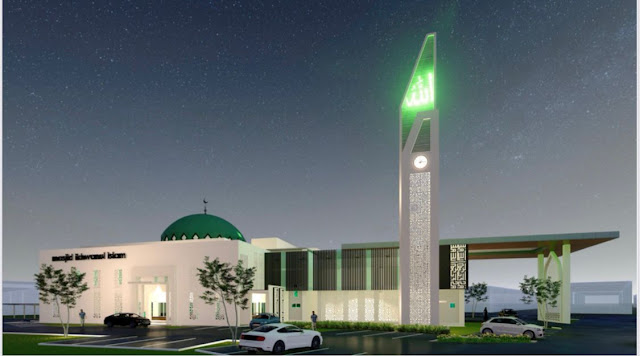
Pening kepala kerana terdelay disebabkan oleh banyak isu spt pandemik, PKP, kekurangan bahan Binaan dan ketidak masukan pekerja dari negara jiran


December 2016 - Visiting Hainan Island for 5 days playing 4 courses, namely Haikuo Mission Hill (Blackstone), The Dunes, Haikou Mayflower International Golf Club, Hainan Dongshan Golf Course,


The Royale Jakarta Golf Course stands true to its title, accredited to being Jakarta’s very own world-class Championship Course.
In line with international standards of golfing, this course combines the finesse of standards with astounding panoramic views of Mount Salak and Mount Gede. Adding to its illustrious status, the course is lined with exotic and scientifically explained lush greenery that boasts of 27 holes in 3 sets of 9 holes across various difficulty levels.


Tujuh buah menara yang rata-rata besar dan tinggi, namun menara utamanya yang menempatkani jam gergasi di puncaknya itulah yang menarik perhatian. Menara ini mempunyai 76 tingkat dan 1005 buah bilik hotel 7 bintang,
Sebuah menara jam tertinggi ini telah siap dibina di Mekah. Nama lengkap bagi menara jam ini adalah Menara Jam Diraja Mekah atau popularnya Menara Abraj Al-Bait. Menara jam ini dibina oleh syarikat pembinaan tersohor Arab Saudi iaitu, Saudi Binladin Group membabitkan 250 tenaga kerja mahir umat Islam. Ianya terletak bersebelahan Masjidil Haram di atas tapak Kubu Pertahanan Ajyad di zaman Khalifah Uthmaniyah yang telah diruntuhkan.


Makkah Moden
Sebagai seorang Muslim adakah anda turut merasa hebat, gembira, kagum dan bangga bila diberitahu mengenainya? Di satu sudud, ia memberi gambaran positif bahawa negara Islam telah maju dan telah mampu membina bangunan pencakar langit yang hebat dan mewah. Orang Islam mampu membina bangunan yang luar biasa besar melibatkan 16 juta kaki persegi dan berketinggian 577 meter menjadi yang kedua tertinggi di dunia pada masa ini. Setanding dengan negara yang dikatakan termaju di benua Eropah dan Amerika. Dubai yang telah membina Burj al Khalifa kini di rekodkan sebagai bangunan tertinggi juga sebuah negara Islam.
Menara jam dan perbandingan dengan bangunan sekitarnya
Adakah kerajaan Saudi sedang mempromosi Bandar (Bandaraya?) Suci Makkatul Mukarramah dan Masjidil Haram kepada para penduduk di USA dan Eropah? Memang diketahui umum masyarakat dunia terutamanya di rantau Eropah juga Amerika Utara tentunya USA amat tertarik dengan bangunan tinggi dan mewah lebih-lebih lagi yang berukuran gigantik umpama bangunan di Makkah ini. Secara kasar ia kelihatan sedemikian. Cubaan untuk berdakwah kepada masyarakat dunia moden.
Sesuatu hal yang cukup menakjubkan bagi mereka yang memihak kepada perlumbaan ini. Dunia keseluruhannya amat berminat mengetahui perkara ganjil dan gah dan menjadi kebiasaan bagi masyarakat moden Barat. Secara tidak langsung binaan ini menarik perhatian masyarakat dunia ketika USA, NATO dan Israel sedang melakukan kempen memburuk-burukkan Islam serta membelasah rakyat Pelestin, Afghanistan dan Libya.
Antara yang menarik mengenai kompleks menara jam gigantik ini ialah keseluruhan ruang legarnya amat besar, berukuran 1,500,000 m2 (16,150,000 kaki persegi). 16.1 juta kaki persegi itu sememangnya cukup luas. Ketinggiannya pula melebihi Emirates Park Towers di Dubai yang mana sebelum ini merupakan sebuah hotel tertinggi di dunia..
Bagaimanakah keadaan hotel bertaraf 7 bintang ini? Berapa pula kadar harga penginapan untuk satu hari? Mungkin ada diantara pembaca yang pernah menginap di hotel bertaraf ini.
Makkah Clock Royal Tower - A Fairmont Hotel - Mecca
Kadar Termurah RM633
Moevenpick Hotel & Residence Hajar Tower Makkah, Mecca,
mewah
Raffles Makkah Palace, Mecca,
untuk siapa?
Dari segi ketinggiannya, menara jam ini akan menjadi bangunan kedua tertinggi di dunia dengan ketinggian keseluruhan 601 meter, mengatasi menara Taipei 101 (509 meter) dan berada di belakang Burj Khalifa (828 meter).
Jam yang berada pada setiap sisi menara adalah berukuran 43×43 meter menjadikannya sebagai sebuah jam yang paling besar di dunia. Muka jam yang berdiameter 5 kali lebih besar daripada Big Ben di London itu ditulis dengan nama Allah di atasnya dan akan diterangi dua juta cahaya LED. Menara itu turut dilengkapi 21,000 cahaya putih dan hijau yang akan berkilauan sejauh 30 kilometer sebagai pemberitahuan bagi lima waktu solat fardu.
Jam ini mengguna pakai waktu standard Arab Saudi, tiga jam ke hadapan daripada Waktu Rasmi Dunia (Universal Time Standard). Terdapat ura-ura mengatakan menara jam tersebut bakal menggantikan Universal Time Standard yang sudah berusia melebihi 126 tahun yang lebih dikenali sebagai Greenwich Mean Time (GMT). Dalam persidangan di Doha pada 2008, ulama dan cendekiawan Islam berpendapat waktu di Makkah adalah waktu sebenar meridian dunia kerana kedudukan Mekah di tengah-tengah dunia.
Mangroves are dank, dark and eerie, places we might imagine foul creatures call home. They are neither interesting nor glamorous for most people but they are important. We cannot afford to lose them, writes CHAI MEI LING.
WHY are mangroves so important? What's so appealing about a place with roots jutting out from the mud? Mangroves are dark and eerie, places where creatures like the Swamp Thing, if it existed, would feel at home in.

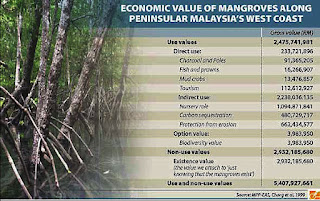
Not many know, however, that from mangroves we get more than RM5.5 billion worth of services and products -- delicious seafood, potable water and clean air, among others. And that's from along the west coast of Peninsular Malaysia alone, a study has revealed.
If the ecosystem were an employee, we would have to pay it a handsome sum of RM40,000 per hectare a year.
For the longest time, mangroves have been "one of the most unlikeable if not misunderstood places on Earth", says mangrove expert Professor Dr Chong Ving Ching.
He says few can walk there without sinking deep into foul smelling mud or be beset by insects.

"It's perhaps for this reason that one-third of the world's mangrove forests have been lost to development over the past 50 years. Yet mangroves provide for us in so many ways."
Chong was speaking at a lecture in Universiti Malaya recently.
Interestingly, some of the most prominent roles of mangroves are not visible -- nurturing fishery, storing carbon and protecting the west coast from erosion.
This "invisible work" is worth nothing less than RM2.2 billion -- almost 10 times the value of mangroves' direct roles in the tourism, seafood and charcoal trade.
The 2004 tsunami helped spark appreciation for mangroves as coasts naked of mangroves were ravaged.
Since then, researchers, policymakers, green groups, coastal folk, fishermen, students and members of the public have taken part in mangrove rehabilitation exercises to increase their cover.
Mangrove wetlands occupy 567,000ha in Malaysia, comprising some three per cent of the world's mangroves of 18 million hectares.
Chong says the role of mangroves in fisheries is the most economically important one. Fish, prawn and mud crab harvests from its habitat along the west coast are worth some RM30 million.
The ecosystem's nursery role for inshore and offshore fish and prawns is valued at another RM1 billion, hence the linkages between mangroves and fish production are "real and strong".
Studies of the Matang mangroves in Perak and Klang mangroves in Selangor indicate that between 50 and 70 per cent of fish and more than 95 per cent of prawns caught depend on the mangroves to get them through their juvenile stages.
 Many are commercially important, like the sea perch (siakap), banana prawn (udang putih) and mud crab (ketam batu).
Mangroves do not just feed young marine life, but also act as shelter, its gnarly roots home to prawns.
In a study three years ago, Chong found that the prawns penetrated as far as 56m inside the mangrove forest of Matang during high tide.
Scientists believe that Malaysia is "the centre of origin of mangrove evolution and dispersal", says Chong.
"The origin of the word 'mangrove' is also Malaysian, its root word is manggi-manggi. Mangroves, therefore, have a special meaning to us."
Fast vanishing
WHEN the mangroves go, so, too, will our fishes.
In a study this year which documented threats to Malaysian fishes, Prof Dr Chong Ving Ching and colleagues found habitat loss accounted for three-quarters of our dwindling stock. Other causes, such as over-harvesting, by-catch, pollution and human disturbance, did not come close to the danger posed by habitat degradation.
The country has some 567,000ha of mangroves. Sabah tops the list, followed by Sarawak, Perak and Johor. Of the total cover, 23 per cent or 130,000ha are on state land. Some three-quarters of Sarawak’s mangroves are on state land.
As states are not legally bound to preserve tracts of this ecosystem, the mangroves are especially vulnerable to development.
They can be wiped out “with just a stroke of the pen”, says Chong.
Kelantan and Perlis have very little mangrove, with a cover of 744ha and 13ha respectively, but neither has been gazetted as a forest reserve. Gazetting serves as a form of protection, although not permanent.
The country lost 69,000ha, or 14 per cent of its mangrove forest reserve, between 1980 and 2004. During that period, Negri Sembilan degazetted 85 per cent of its forest reserve, Terengganu, 57 per cent, and Selangor 47 per cent. Penang and Johor lost a third of theirs, and Sarawak one-fifth.
Read more: Misunderstood mangroves http://www.nst.com.my/nst/articles/26bakau-2/Article/#ixzz10dTIXEN8
WHY are mangroves so important? What's so appealing about a place with roots jutting out from the mud? Mangroves are dark and eerie, places where creatures like the Swamp Thing, if it existed, would feel at home in.

Not many know, however, that from mangroves we get more than RM5.5 billion worth of services and products -- delicious seafood, potable water and clean air, among others. And that's from along the west coast of Peninsular Malaysia alone, a study has revealed.
If the ecosystem were an employee, we would have to pay it a handsome sum of RM40,000 per hectare a year.
For the longest time, mangroves have been "one of the most unlikeable if not misunderstood places on Earth", says mangrove expert Professor Dr Chong Ving Ching.
He says few can walk there without sinking deep into foul smelling mud or be beset by insects.

"It's perhaps for this reason that one-third of the world's mangrove forests have been lost to development over the past 50 years. Yet mangroves provide for us in so many ways."
Chong was speaking at a lecture in Universiti Malaya recently.
Interestingly, some of the most prominent roles of mangroves are not visible -- nurturing fishery, storing carbon and protecting the west coast from erosion.
This "invisible work" is worth nothing less than RM2.2 billion -- almost 10 times the value of mangroves' direct roles in the tourism, seafood and charcoal trade.
The 2004 tsunami helped spark appreciation for mangroves as coasts naked of mangroves were ravaged.
Since then, researchers, policymakers, green groups, coastal folk, fishermen, students and members of the public have taken part in mangrove rehabilitation exercises to increase their cover.
Mangrove wetlands occupy 567,000ha in Malaysia, comprising some three per cent of the world's mangroves of 18 million hectares.
Chong says the role of mangroves in fisheries is the most economically important one. Fish, prawn and mud crab harvests from its habitat along the west coast are worth some RM30 million.
The ecosystem's nursery role for inshore and offshore fish and prawns is valued at another RM1 billion, hence the linkages between mangroves and fish production are "real and strong".
Studies of the Matang mangroves in Perak and Klang mangroves in Selangor indicate that between 50 and 70 per cent of fish and more than 95 per cent of prawns caught depend on the mangroves to get them through their juvenile stages.

Mangroves do not just feed young marine life, but also act as shelter, its gnarly roots home to prawns.
In a study three years ago, Chong found that the prawns penetrated as far as 56m inside the mangrove forest of Matang during high tide.
Scientists believe that Malaysia is "the centre of origin of mangrove evolution and dispersal", says Chong.
"The origin of the word 'mangrove' is also Malaysian, its root word is manggi-manggi. Mangroves, therefore, have a special meaning to us."
Fast vanishing
WHEN the mangroves go, so, too, will our fishes.
In a study this year which documented threats to Malaysian fishes, Prof Dr Chong Ving Ching and colleagues found habitat loss accounted for three-quarters of our dwindling stock. Other causes, such as over-harvesting, by-catch, pollution and human disturbance, did not come close to the danger posed by habitat degradation.
The country has some 567,000ha of mangroves. Sabah tops the list, followed by Sarawak, Perak and Johor. Of the total cover, 23 per cent or 130,000ha are on state land. Some three-quarters of Sarawak’s mangroves are on state land.
As states are not legally bound to preserve tracts of this ecosystem, the mangroves are especially vulnerable to development.
They can be wiped out “with just a stroke of the pen”, says Chong.
Kelantan and Perlis have very little mangrove, with a cover of 744ha and 13ha respectively, but neither has been gazetted as a forest reserve. Gazetting serves as a form of protection, although not permanent.
The country lost 69,000ha, or 14 per cent of its mangrove forest reserve, between 1980 and 2004. During that period, Negri Sembilan degazetted 85 per cent of its forest reserve, Terengganu, 57 per cent, and Selangor 47 per cent. Penang and Johor lost a third of theirs, and Sarawak one-fifth.
Read more: Misunderstood mangroves http://www.nst.com.my/nst/articles/26bakau-2/Article/#ixzz10dTIXEN8

Professor White: Future of the web is tied to the future of mankind.
Professor White: Future of the web is tied to the future of mankind.
No one could have predicted its impact on society today. Likewise, no one can tell where is it heading to.
“Nobody can predict the future of the Web. It just happened and will continue to happen beyond our control. Predictions for the future Web worry me as they are largely based on technologies, not so much on the way people are using the Web, which should be the most important variable,” said Professor Emeritus Bebo White, a visiting American professor.
He was the key speaker at a recent seminar titled ‘Shaping the Future Web’, organised by the Sarawak ICT Development & Media Network and University Malaysia Sarawak (Unimas) for the local journalists on contemporary ICT matters and trends.
“The future of the Web is tied to the future of mankind. Web users have expectations of fulfillment — that is the Web should give them what they need when they need it. It is a Web that works for everybody, no matter where they are, what devices they use or what language they speak. The future Web, so to speak, depends on benefit or proof of benefit,” he said.
According to White, there are many contributors to the future of the Web, one of them being what is known as the Social Web.
“Social Web is the ‘elephant in the room’ right now because it has the biggest influence on society. This is the technology that shapes the perspective of life through various social networking sites such as Facebook as more people are accessing the Web from mobile devices rather than their desktop computers,” he explained.
White has some big ideas for the Social Web.
“Nowadays, it is important for people to have the most current and useful data, refreshed and available quickly. Social Web should allow users to access and manipulate those data and get them directly from the source or the people who created the data,” he said in his presentation.
He added that Social Web should contain easily adaptable ‘living’ applications, including personalisation of how we want to see the data.
“It should also provide for a collective experience for users by contributing to their different lifestyles. For example, Amazon.com allows users to share reviews that can be read by others and used for decision-making.
“The Web is a platform in which social environments can be modified. In the early days, publishing a website would mean having the knowledge to write html codes, looking for hosting and the like. Today, web publishing is made simple by blogs and microblogs like Twitter.”
In other words, there is no need to worry about technical details. Users can now focus on participation instead of just publishing.
White further highlighted the growing importance of the Social Web with the ‘Five Eras of the Social Web’, developed by independent technology and market research company Forrester Research. The information describes the ways that Forrester researchers see the Web is moving to.
“In the ‘Era of Social Relationships’, individuals assemble and connect with each other in online groups. They use simple profiles and discussion features to share with one another. It really redefines what a ‘friend’ means.
“The ‘Era of Social Functionality’ is scary to me. This is where social networks become operating systems. This is basically doing everything in one site, from checking emails to reading news. Users do not need to go outside that environment.”
White also explained at length the other eras — the ‘Era of Social Colonisation’ where technologies are seen to break down the barriers of social network and allow individuals to integrate their social connections as part of their online experience; the ‘Era of Social Context’ where sites will recognise personal identities and social relationships to deliver a fully customised online experience and finally the ‘Era of Social Commerce’ where social networks become more powerful than corporate websites as individual identities and relationships are built on this platform.
However, he emphasised that these were just potential impact to the future of the Web, not a sure definition of its direction.
For journalism, White believed the Web will not eliminate traditional media despite the advent of online media.
“I live in San Francisco, so I subscribe to San Francisco Chronicle. I also read the online version but some articles are not published immediately on the same day of print. So unless people are willing to get their news a day late, they still need to buy for a physical copy of the paper. The Web version is good for searching past articles,” he said, adding that both traditional and online media could co-exist to complement one another.
White is a Departmental Associate (retired) at the Stanford Linear Accelerator Centre (SLAC), the high-energy physics and basic energy science laboratory operated by Stanford University in California.
During his career, he was involved with the development of World Wide Web technology since its earliest days at CERN in Geneva, Switzerland. He was also among the original ‘Web Wizards’ who established the first website in the US and the fifth in the world — the SLAC site.
“The SLAC website grew out of SLAC’s collaboration with CERN. SLAC supports a research paper preprints database widely used by physicists around the world. When it was found that Web technology could provide ready access to that database, which had previously been difficult, we were convinced of the value of the Web.
“Setup did not take very long, perhaps a matter of weeks. No one who worked on this project had any idea that the Web would become as popular and useful as it is today,” the professor told thesundaypost after the seminar.
This was his second official trip to Kuching.
“I like Kuching very much. The place is beautiful and the people are wonderful. However, I do not think I will ever get accustomed to the heat and humidity. After Kuching, I’m travelling to Hong Kong where I’m a Visiting Professor at Hong Kong University for one of my regular teaching assignments,” he said.
Despite his retirement, White does go to SLAC regularly since he still has an office there. He would participate in some projects and provide consultations for some students.
“I’m currently working on Web Science and Web Engineering. I’m also editing a book for Springer Publications on the application of social media technology in education,” he revealed.
On his most memorable conference during his career, White said there were too many to name.
“I have been to so many and chaired a few. I guess I would have to say the 1992 ‘Computing in High Energy Physics (CHEP)’ conference in Annecy, France. That was the conference when the Web was formally introduced to the high-energy physics community.
“Really, the best part of my career would be the opportunities to travel and teach all over the world. I have been extremely lucky in that sense,” he added.
Besides academic-related activities, White also plays for a jug band which employs a jug player and a mix of traditional and home-made instruments known as The Tarantulas. He is also the president of the California Jug Band Association.
“I’m hoping we will be able to get a jug band to play at the 2011 Rainforest World Music Festival. That’s when I’m planning to return to Kuching and Unimas,” he said.
by Antonia Chiam
September 5, 2010, Sunday
Many individuals undergo periodic fasting for health, religious or cultural reasons. In Ramadan, Muslims abstain from food, drink, sex and tobacco from early in the dawn (imsak) until dusk (maghrib).
This period involves a shift in the pattern of intake from day time to the hours of darkness. fasting is characterized by a coordinated set of metabolic changes designed to spare carbohydrates and increase reliance on fat as a substrate for energy supply.
As well as sparing the limited endogenous carbohydrate, and increased rate of gluconeogenesis, glucose production from amino acids, glycerol and ketone bodies, help maintain the supply of carbohydrates. There seems to be little effect on overall daily dietary intake and only small metabolic effects, but there may be implications for both physical and cognitive function.
The study from Abdul Rashid Aziz from Singapore Sports Institute this year examines the effects of Ramadan fasting on endurance performance. A method using a crossover design, 10 moderately trained, active Muslim men performed 60 minutes runs on a treadmill in the fasted (Ramadan, RAM) and non-fasted (Control, CON) states on two separate counterbalanced occasions.
After familiarization, four subjects performed their CON trial one week before Ramadan, while the other six subjects performed their CON trial one week after Ramadan. The subjects’ last meals were standardized before their exercise trials.
The results: Blood glucose concentration was significantly lower and urine specific gravity was significantly higher at the start of exercise in the RAM condition than in CON.
Physiological responses during the 30-minute run (mean heart rate, blood lactate and ratings of perceived exertion) were, however, not significantly different between the two conditions.
There were also no significant difference in the subjects’ daytime sleepiness or mood profile between the RAM and CON conditions. At the conclusion of this study, Ramadan fasting has a small yet significant negative impact on endurance running performance, although the impact varies across individuals.
The study from A. Michaelsen, et al, from Kliniken Essen Mitte, Germany, stated that it was commonly reported that short-term fasting leads to mood enhancement and emotional harmonization.
Michaelsen investigated psychosocial well-being and the neuroendocrine response, assessed by nightly urinary excretion of cortisol and catecholamines hormones, in 28 inpatients with chronic pain syndromes during and after a one-week modified fast.
Twenty-two of the patients participated in a seven-day fasting with daily intake of 300 kcal/day, six control patients received a vegetarian-based diet. With fasting, significant increases of the urinary concentration of noradrenaline, adrenaline and cortisol were observed, whereas controls showed no significant endocrine changes.
The neuroendocrine response to fasting was pronounced in younger subjects (age <50 years) and in the presence of a BMI (Body Mass Index) >25 kg/m2, moreover the increase in cortisol excretion was significantly higher in subjects with lower baseline cortisol levels.
Mood and well-being increased non-significantly in both groups. Fasting was well tolerated, and regarded as beneficial by most fasting patients. Our results show that short-term fasting leads to neuroendocrine activation and may suggest that the extent of this response is dependent on the individual metabolic and endocrine state at baseline.
“Good diet and modifications to sleep and work timetables may minimize or even eliminate any
effects on performance.”
Good fasting has both spiritual and health benefits. Studies have shown that fasting can induce a healthy condition to our body and reduce the amount of cholesterol in the blood.
Too much cholesterol in the blood causes plaque to build up on the walls of arteries and veins, which could lead to clotting and a stroke. Fasting is also said to boost the immune system and the metabolism, thus promoting healing.
Restricting caloric intake also slows down the production of free radicals in the body, which can help prevent degenerative diseases. A recent study carried out in Indonesia has concluded that fasting can reduce the amount of free radicals in the body by about 90 percent and increase the antioxidant level by around 12 percent. Fasting also can decrease body weight. Nutritionist Ali Khomsan said many Muslims lost 5 percent of their body weight in Ramadan.
To maintain a healthy and active lifestyle, it is necessary to have a diet that is balanced enough. The principles of good nutrition hold true for anyone who is fasting. It is best to avoid too much fat, sugar, salt and caffeine and to always choose fresh non-processed food. It is important to drink at least seven glasses of water a day — three in the morning at sahur and four in the evening.
Fifty percent of food consumed should be at the time when you break your fast, 10 percent after the tarawih prayer and 40 percent at sahur time. It is best to break the fast with foods such as dates or bananas that will quickly release glucose into the bloodstream.
Let the stomach rest for one hour after that before eating rice or anything more substantial. It is a good idea to choose food from each of the major food groups: the grain group, the fruit and vegetable group and the meat and dairy groups. The meat group includes vegetarian options such as nuts and beans.
Finally, it is true that in the first week of fasting we feel tired. This is normal and indicates the body needs time to adapt. Avoid strenuous activity in the fasting month but do not allow yourself to get lazy.
Increases in subjective sensations of fatigue may be the result of loss of sleep or disruption of normal sleep patterns. Good diet and modifications to sleep and work timetables may minimize or even eliminate any effects on performance. So, fasting has been found to be really healthy and does not decrease our performance.
May22, 2010 - After experiencing the Cu Chi Tunnel we went straight to Ho Chih Minh City, formally known as Saigon to get the feeling of walking around the city. People were friendly and persistently offering you their products. The first photo was taken before the Vietnam War.


 |
| Roadside Trader before the Vietnam War |
 |
| Roadside Trader 2010 |
 |
| Bargaining by the roadside |
 |
| Smoking and sleeping by the roadside |
 |
| This shop export fabric to Malaysia |
 |
| Selling Books and Newspaper |
 |
| Selling drinks to Tourist from Malaysia |
 |
| Sleeping by the roadside |
 |
| Hosting Lunch at the roadside |

 |
| Mobile Trader selling Mobile Phone |
 |
| Selling live stock |


On our 2nd day in HCMC we started early to Cu Chi Tunnel which was situated at Cu Chi district. The district has a population of about 200,000 (80,000 during the American War). At first glance there was little evidence here to indicate the intense fighting, bombing and distruction that occured during the war.
The tunnel network became lagendary during the 1960s for its role in facilitating the Viet Cong (VC) control the area. The system stretched from here to the Cambodian border. Its faciliated communication and coordination between the VC-controlled enclaves, isolated by each other from south Vietnamese and American - land and air - operation.
"Cu Chi Tunnel is 70 km from Ho Chi Minh City in the Northwest. It is miniature battle versatile of Cu Chi’s military and people during the 30-year struggle longtime and fierce to fight invading enemy to receive independence, freedom for motherland. It also is the special architecture lying deeply underground with many stratums, nooks and crannies as complex as a cobweb, having spares for living, meeting and fighting with total lengths over 200 km.... Read more here
 |
| Tourist Guide showing how the Viet Cong entered the tunnel |
 |
| Too big for the tunnel |
 |
| Traps with bamboo spikes |
 |
| Tunnel Ventilation |
 |
| Tourist Guide explaining how the Vietnamese trapped the US armies |
 |
| One of the deadly traps |
 |
| Tunnel Door. From this tunnel the VC mount surprise attack on the US army |
 |
| US Bomb52 crater |
 |
| Vietnamese hamlet |
 |
| With the Viet Cong army |
 |
| Group of British tourists |
 |
| Captured US Tanker |
 |
| Shooting Range |
 |
| Making slippers and shoes for Viet Cong Army |

 |
| We were served with tapioca and drinks |

Sarawak Perahu Tambang Association chairman Rosli Hidin said that any initiative to help the operators should be continuous.
He said they wanted the authorities and agencies to promote the perahu tambang service as a niche tourism product in the state.
“We hope that hotels and travel agencies can market the ride to their customers.
“Only through such co-operation can our business be sustained,” he told StarMetro after launching the Adopt-A-Tambang programme organised by the Tourism and Heritage Ministry at the Kuching Waterfront recently.
Slowing trade: File photo of perahu tambang operators having a field day watching the Sarawak Regatta 2010 from the riverbank.
Rosli said the association’s members welcomed the programme seen as an initiative to improve their service and income.
Giving them one-off cash assistance to refurbish their boats was not enough to assure good business, he said.
“We hope the agencies which have adopted our members will introduce the perahu tambang to their guests.
“We cannot rely on our 40 sen fare to cross the river to survive. We need the support of the relevant agencies in terms or promotion of our services,” he added.
Rosli said the charges for a one-hour perahu tambang ride was RM15 during the day time and RM16 at night.
To keep up with standards, he said the association would monitor the members to make sure their boats were clean and equipped with life jackets.
Friday August 13, 2010
By RINTOS MAIL
rintos@thestar.com.my